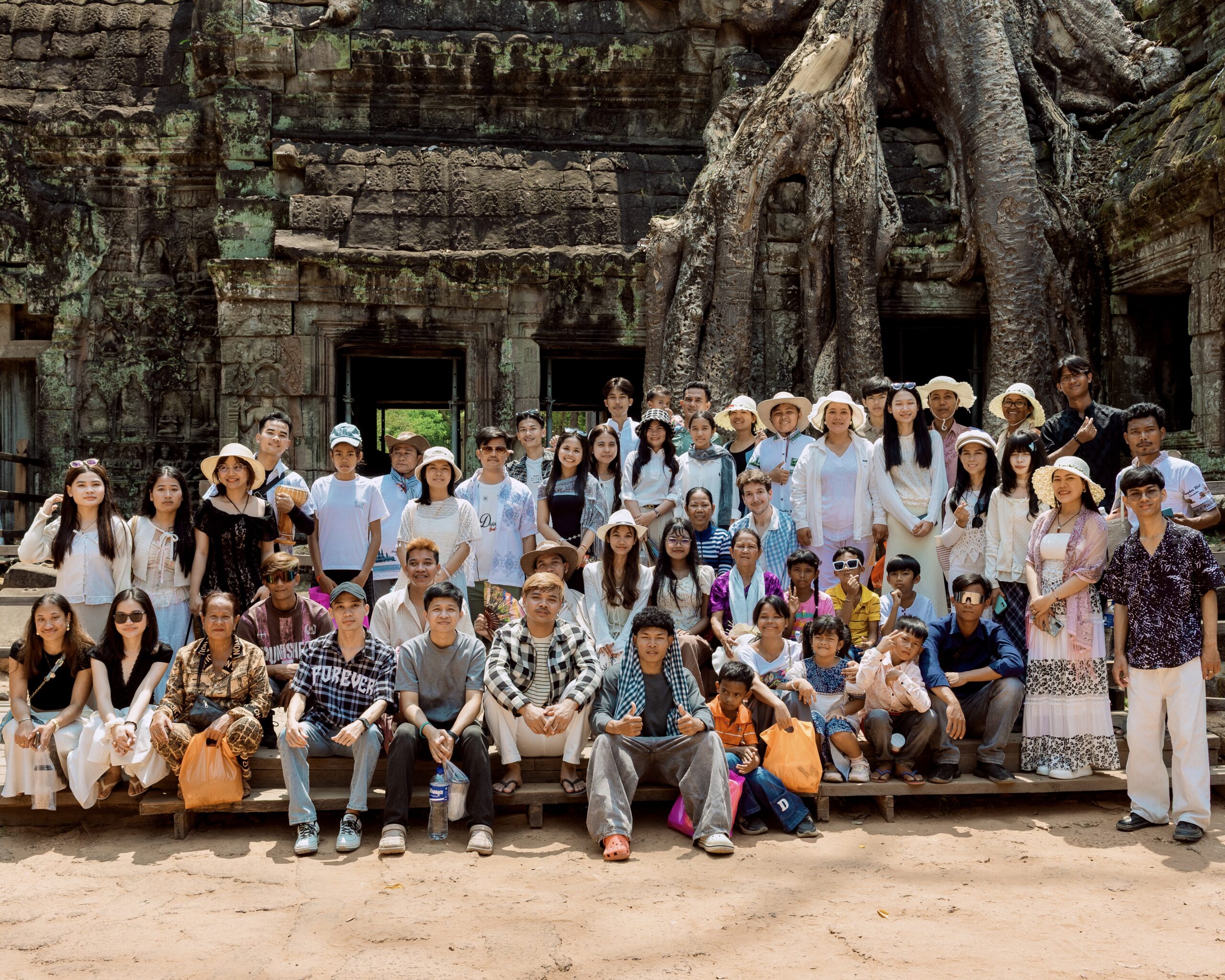
For years, I had secretly dreamed of making this happen, though I was never sure whether it would actually become a reality.
Over the years, it has become deeply important to me to spend major Khmer holidays on-site in Cambodia. Holiday seasons are always festive and meaningful in every culture, but for many of our students, these occasions can also be difficult, as a large number of them does’t have a traditional familial background to spend their holidays with or a “home” to return to. It often happens that, while all of their university friends and coworkers travel to their hometowns to celebrate meaningful get-togethers with their loved ones, our students are left spending these moments along.
As our organization gradually became a kind of “found family” for many students and beneficiaries, I began making it a priority to travel to Cambodia during the Pchum Ben holidays whenever my work schedule allowed it. Pchum Ben is a deeply spiritual holiday that centers around honoring one’s ancestors and participating in traditional ceremonies and prayers at local Buddhist pagodas. Over time, this became a tradition for us, and several of our students count on me to plan our days at the pagodas and to organize a big family dinner every year.
While, as mentioned, the Pchum Ben holidays mainly revolve around one’s ancestry and the deceased, the Khmer New Year holiday, which takes place in April, is a more lighthearted celebration. Several events take place across the country in the weeks leading up to the public holidays, with offices, businesses, universities, and schools often hosting their very own festivities. Traditional games are played everywhere, including “hit the target” games, a variety of tag games, blindfolded contests, and tug of war.
Larger universities also set up stages and host concerts with performances ranging from traditional apsara dances and Khmer boxing demonstrations to today’s most popular singers and rappers. On top of that, public “Sangkrant” celebrations take place, which are street festivals filled with music, dancing, water fights and playful powder battles.
For those Cambodians who can afford it, traveling to Siem Reap during Khmer New Year is a cherished tradition. This is where most of the ancient temples of the Angkor Empire are located, which are free of entry for Cambodians during the holidays, and hold a immense cultural and spiritual significance. However, all of our students and beneficiaries come from poverty-stricken communities, and many grew up orphaned, facing numerous challenges and struggling to make ends meet. It goes without saying that the experience of traveling and “going on trips” is a privilege and luxury that people who live in extreme poverty don’t get to experience. And although all of our students and beneficiaries look happy and healthy in the photos that we share on our platforms, this is solely thanks to support from organizations like ours that ensure that they are cared for and supported.
Therefore, the absolute majority of our students had never gotten the chance to see Angkor Wat, the iconic national landmark that draws millions of international tourists every single year, the symbol of Khmer pride, and the country’s rich cultural heritage, with their own eyes.
Therefore, it had been my dream to one day invite all of our students and beneficiaries on a special trip to Siem Reap so that they could experience these extraordinary temples firsthand. And this year, that dream finally became reality.
After months of planning and several extremely intense weeks working on-site in Cambodia this April, our big Khmer New Year journey finally began on April 14th. Although not all of our students and beneficiaries could join due to work and study obligations or health-related reasons, we still ended up being a group of 65 people. Organizing a trip for this many people meant reanting a bus, a van, and practically an entire hotel for four days.
Our group was truly ecstatic to embark on this trip, and the atmosphere was magical from the first second on. Just like every bus in Cambodia, our bus also had microphones and speakers to connect our phones with, allowing us to sing karaoke, dance, and entertain each other for the entirety of the six-hour ride from Phnom Penh to Siem Reap.
After checking into our hotel, which, much to our students’ delight, also had a rooftop pool, I took our group to an all-you-can-eat buffet dinner. Afterwards, our group split up with some returning to the hotel to swim in a pool for the first time in their lives, or getting their much-needed sleep, and others joining the first of many public Sangkrant water fights and concerts.
On April 15th, our first full day in Siem Reap, two tour guides picked us up in three minivans for a full day of temple exploration. Our first stop was Bayon temple, an iconic masterpiece that dates all the way back to the 12th century and is one of Cambodia’s most unforgettable landmarks.
Known for its 216 stone faces gazing out from multiple towers, every corner of Bayon is extremely impressive. With more than 11 million intricate carvings woven into its walls, you could literally spend entire days at this landmark and still continue discovering new details.
Previous
Next
Previous
Next
Next, we visited the breathtaking Ta Prohm temple, a historic site that dates back to the 13th century. Left largely untouched after centuries of abandonment, nature has intertwined with its ruins. Massive tree roots wrap around ancient stones, and entire tree trunks rise high above the temple’s roofs, creating a truly surreal and unforgettable setting. It was an enchanting place for our students to explore and capture their first memories of these incredible temples.
Previous
Next
Previous
Next
Of course, no temple tour would be complete without visiting the most iconic site of them all: Angkor Wat.
Angkor Wat is the largest religious complex in the world and dates back to the 12th century. It has a deep spiritual meaning to Cambodians and is also pictured on the country’s flag, making it the only flag to showcase a building. Being able to visit this site on the biggest holiday of the year was truly special and one of the main reasons why I wanted to make this trip happen. It was definitely an equally special and emotional experience for our group, and we ended up spending several hours at the temple site to discover as much as we possibly could. Beyond the photos, beyond the beauty, this visit was about building a connection to our students’ country’s history and culture, while also enabling them to connect with their roots, reflecting on their country’s legacy, and strengthening their sense of belonging.
Previous
Next
Previous
Next
While these were already an overwhelming number of new impressions for our students, I couldn’t help but take them out to a buffet dinner that included a beautiful Apsara dance performance. Apsara dance is one of Cambodia’s most treasured artistic traditions, with each dance telling stories rooted in Khmer folklore, with different costumes, elaborate choreographies, and music.
Our students were truly fascinated, as this was the first time that they had ever gotten to see a professional Apsara performance, and they couldn’t take their eyes off the stage for the entirety of the show.
Later that night, our adult students were excited to join yet another Sangkrant concert, dancing late into the night to the music of a Cambodian DJ.
On day three, we were joined by another local tour guide who wanted to take us on a more unconventional journey to explore local culture and food. The first stop was Preah Enkosei temple, the oldest known temple site, which dates all the way back to the mid 10th-century. This visit was particularly meaningful, as there was an active pagoda located on the site next to the ruins, which allowed our group to receive our new year’s blessings, express gratitude, engage in prayers, and welcome the new year together.
Previous
Next
Previous
Next
Afterwards, we were able to visit Preah Dak village, where we learned everything about the palm juice and palm cake production process up close. These palm cakes, known as Num Akao Tnaot, are steamed palm cakes that are particularly local to this area. Needless to say, our students were more than happy to taste these delicious pastries, topped with some fresh shredded coconut, right there.
After a relaxing picnic at West Baray, an ancient water reservoir, our tour ended at Artisans Angkor Silk Farm, where our group had a truly special cultural experience: discovering the ancient art of Cambodian silk-making from start to finish.
Our guide walked us through every step of the process, from breeding and hatching silkworms, to harvesting silk cocoons, through weaving and dying processes, and finally creating the finished garment by hand. The Artisans Angkor silk farm is not only a beautiful space dedicated to preserving tradition and craftsmanship, but also a small enterprise that creates meaningful employment opportunities for rural Khmer youth.
Our group truly enjoyed the visit and were fascinated to learn more about Cambodian handmake silk, yet another beautiful part of their very own culture that they had never gotten the chance to experience first-hand.
Previous
Next
After this eventful day, I wanted to give our group some time to breathe and decompress before we eventually grouped up to celebrate one last night of the new year’s parties on the streets of Siem Reap. This time, we attended a DJ set at the biggest stage that was set up in the town, getting soaking wet in the public water fights and our faces smeared with colorful baby powder, allowing our students to escape the worries and challenges of everyday live for one last night.
On our final day, before leaving Siem Reap, we visited the “Art for Peace” artwork. This was an initiative that was brought to life in response to the escalated Thai border conflict in 2025 with over 60 artists uniting to create a beautiful mural in the heart of the town. The artwork reflects the devastating impact that war has on civilians and showcases stories of loss, suffering, and resilience.
It felt very meaningful to be able to take a look at this unique piece of art ourselves, albeit deeply moving for our group. Most importantly, however, it served as a reminder that Cambodians always stand for peace and perseverance.
Before beginning our journey back home, we made one final stop at Angkor Wonder Garden, a beautiful garden area just outside Siem Reap featuring cafés, flowers, and open spaces to relax. Our students spent the afternoon taking countless photos, laughing together, and driving small rental carts around the grounds, ending the trip with pure joy and unforgettable memories.
Previous
Next
In hindsight, these four days in Siem Reap felt like a fever dream. When I started planning this trip for 65 people aged from just three months old all the way to over sixty years old, hiring three tour guides, two professional photographers, multiple drivers, and renting out entire restaurants to make sure that we are well-fed and well taken care of at all times, I could have never imagined that everything would actually go as smoothly as it did. With a group of this size, with lots of young children and elderly people from rural areas who had never seen the world outside of their little villages in the South of Cambodia, it was my biggest concern that someone would get lost or hurt. Fortunately, none of these worries became reality, and the only burden we felt was the level of exhaustion and sleep deprivation that we collectively had by day four.
I am truly happy and blessed that we got to share this experience as a found family. This was truly a once-in-a-lifetime experience that every single member of our group will cherish forever.
And while I am happy that I was able to make this first-time experience become a reality, I certainly hope that this will not be the last time that our students get to travel to Siem Reap.
Note: This entire trip was funded personally and independently and no donations were used for any activities
Wir setzen auf unserer Website ausschließlich essenzielle Cookies ein. Diese sind erforderlich, damit die Website funktioniert und Sie sie benutzen können. Deswegen können Sie ihren Einsatz auch nicht ablehnen. Welche Cookies wir genau verwenden, erfahren Sie in unserer Datenschutzerklärung.
This website uses cookies to improve your experience while you navigate through the website. Out of these, the cookies that are categorized as necessary are stored on your browser as they are essential for the working of basic functionalities of the website. We also use third-party cookies that help us analyze and understand how you use this website. These cookies will be stored in your browser only with your consent. You also have the option to opt-out of these cookies. But opting out of some of these cookies may affect your browsing experience.
Necessary cookies are absolutely essential for the website to function properly. These cookies ensure basic functionalities and security features of the website, anonymously.
Cookie
Duration
Description
cookielawinfo-checbox-analytics
11 months
This cookie is set by GDPR Cookie Consent plugin. The cookie is used to store the user consent for the cookies in the category "Analytics".
cookielawinfo-checbox-functional
11 months
The cookie is set by GDPR cookie consent to record the user consent for the cookies in the category "Functional".
cookielawinfo-checbox-others
11 months
This cookie is set by GDPR Cookie Consent plugin. The cookie is used to store the user consent for the cookies in the category "Other.
cookielawinfo-checkbox-necessary
11 months
This cookie is set by GDPR Cookie Consent plugin. The cookies is used to store the user consent for the cookies in the category "Necessary".
cookielawinfo-checkbox-performance
11 months
This cookie is set by GDPR Cookie Consent plugin. The cookie is used to store the user consent for the cookies in the category "Performance".
viewed_cookie_policy
11 months
The cookie is set by the GDPR Cookie Consent plugin and is used to store whether or not user has consented to the use of cookies. It does not store any personal data.
Functional cookies help to perform certain functionalities like sharing the content of the website on social media platforms, collect feedbacks, and other third-party features.
Performance cookies are used to understand and analyze the key performance indexes of the website which helps in delivering a better user experience for the visitors.
Analytical cookies are used to understand how visitors interact with the website. These cookies help provide information on metrics the number of visitors, bounce rate, traffic source, etc.
Advertisement cookies are used to provide visitors with relevant ads and marketing campaigns. These cookies track visitors across websites and collect information to provide customized ads.